
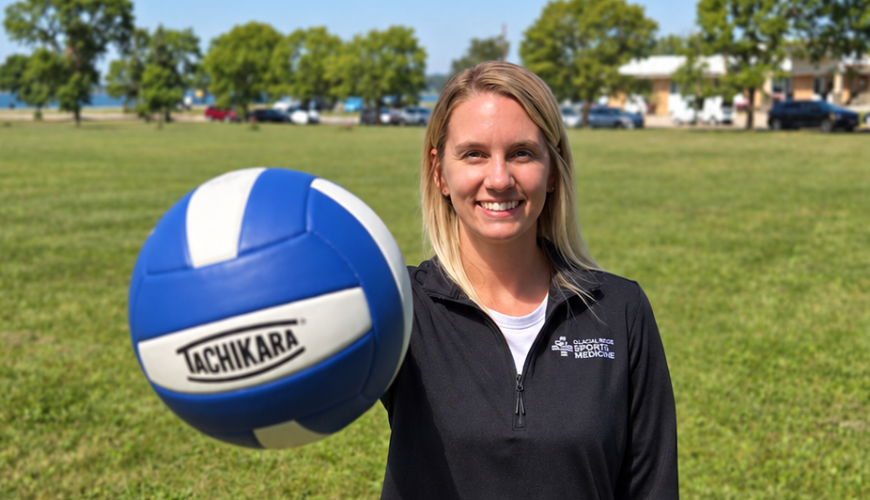
By Shauney Gloege, PT, DPT, TPS; Physical Therapy, Therapeutic Pain Specialist
You’ve had enough time for your body to heal, you’ve completed rehab, you’ve passed the tests, your provider has told you you’re clear to return to activity, yet when you step on the court, the field, the track, you hesitate. “What if it happens again?” “Am I ready for this?” “What if it hurts?” Your body may be ready, but you don’t feel ready.
Why does this happen?
An injury can teach your nervous system that a particular movement, situation, or activity is threatening or dangerous, so when you go back to that activity or even a similar activity, your nervous system is on high alert and extra cautious. It’s saying: “Last time, we got injured, so we know it could be dangerous. Are we sure it’s safe?” This response is intended to protect you but can be very inhibiting when it comes to getting back to activities.
What does lack of confidence look like?
Everyone’s experience is unique, so lack of confidence can look different to everyone:
- Hesitating before cutting or jumping
- Favoring one side
- Avoiding certain movements
- Holding back on performance
- Not committing fully to a movement
- Constantly thinking about the injured body part
- Feeling nervous before or during the activity
- Avoiding situations where the injury originally occurred
- Performing well in controlled environments or drills but struggling during game play
You likely won’t even experience pain, but you may feel like something doesn’t feel right.
What to do: Confidence is built through experience.
We can’t just convince ourselves, “Just be confident.” Our nervous system and brain do not work that way. Yes, mantras can be helpful, but we must build “evidence” to convince our nervous system that the activity is safe again. Every successful repetition and experience gives the brain another piece of evidence. It says, “I did that movement, and I was okay”
So, what does this look like? Think of an activity that you participate in: running, pickleball, golf, baseball, volleyball, etc. The end goal is usually being able to play or compete in a normal game.
To get back to that level, you will need to break it down into smaller steps:
Double-leg landing → single-leg landing → jumping with movement or over an obstacle → cutting drills at controlled speeds → reactive cutting drills → sport-specific drills → participation in full practice → visualization drills of playing in a game → playing in the game
The goal is to break up the tasks you may be nervous about into “smaller chunks” where your body can experience success and relearn that these movements are safe.
Confidence doesn’t mean zero fear.
Being confident doesn’t necessarily mean eliminating all fear. You can be nervous about returning to contact, your first sprint, your first game, whatever it may be, AND still be ready. Confidence isn’t the absence of fear. Confidence is knowing you can move forward despite it.
Healing the body is only one part of returning to activity. You also have to convince your brain it’s safe to move again, and that happens through progressive exposure, successful experiences, and gradually increasing challenge.
If you feel like you need assistance, reach out to any of these professionals who can help you in your return to sport/activity journey: physical and occupational therapists, athletic trainers, coaches, personal trainers, or mental health providers. They can help get you back to what you love to do.